Insights
Raising quality control standards: managing risk precisely with Lot Traceability in ERP
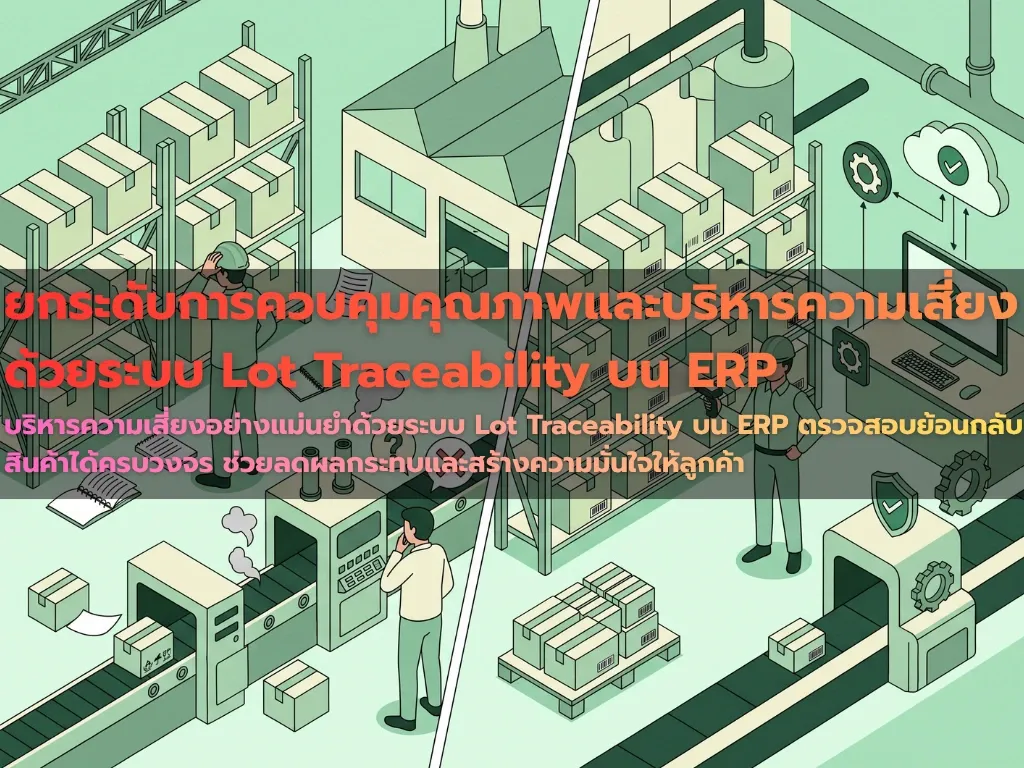
blog
“In manufacturing, maintaining product standards and quality is paramount. But sometimes a hard-to-avoid challenge such as ‘variation in raw material quality’ can occur. What separates an excellent organization from an ordinary one is the ability to trace back (Traceability), so the impact can be contained quickly and precisely.”
When a product or part is found to be out of standard, or an abnormality is found in incoming raw materials, a factory without connected tracking data often needs a great deal of time and resources to find the root cause. In many cases the organization may have to carry out a Product Recall far wider than necessary to be sure consumers are safe, which directly affects cost and confidence in the brand.
The challenge of traceability when data is not connected
Managing the warehouse and the production process through separate systems, or relying on manual records, usually leads to three operating limitations:
- Mass Recall Limitations: When you cannot say specifically which raw material lot went into which finished-goods lot, the organization may have to recall everything produced in that period, creating avoidable wasted cost.
- Shelf-life Management: In industries strict about shelf life (such as food, chemicals or specialty parts), a lack of issue controls can mean staff do not draw materials by the “First Expired, First Out (FEFO)” principle, leaving materials to deteriorate in the warehouse.
- Compliance and Audit Readiness: Being unable to pull up a Traceability Record quickly and systematically can cost the organization its chance of passing international certification (such as ISO) or a major customer’s assessment (Vendor Audit).
Upgrading product tracking with Lot & Serial Traceability in ERP
Leading industrial organizations resolve these limitations with ERP (Enterprise Resource Planning) software that manages data in an integrated way, building highly granular tracking of products and materials at every step:
1. End-to-End Bi-directional Traceability
The ERP system records every movement of a product (Touchpoints), so the organization can check data in two directions in time:
- Backward Traceability (checking the source): When a product problem is found, the system can immediately trace back which machine produced it, and which raw material lot from which supplier was used.
- Forward Traceability (checking the impact): If a raw material lot is found to be faulty, the system looks forward to show which finished-goods lots that lot went into and which customers they were shipped to, so shipments can be stopped in time.
2. Systematic FEFO & FIFO Control
The ERP system can set issue rules at the production line tightly. If materials are issued out of sequence or a lot that is about to expire is skipped, the system alerts and blocks that issue, so material use follows warehouse management standards strictly.
3. Precision Risk Management
Instead of recalling products in large quantities, the ERP system narrows the impact to only the product lots that used the genuinely problematic material, reducing financial loss, and it can produce a summary Report of all the data quickly to reassure customers and auditors.
Conclusion: professional risk management to protect brand confidence
“Mistakes in production can happen, but the ability to respond to and handle problems quickly and precisely is proof of professionalism.”
Investing in an ERP that fully supports Lot and Serial Traceability not only supports working to international standards but is like building a shield against risk, preserving profit and protecting the trust customers place in the organization over the long term.
Raise your quality control standards and the accuracy of your traceability. Consult an ERP implementation specialist for manufacturing and strengthen your back-office system today.
Theoretical references
- Bowersox, D. J., Closs, D. J., & Cooper, M. B. (2012). Supply Chain Logistics Management (4th ed.). McGraw-Hill. (Cited for the principles of traceability in the supply chain for risk management, identifying the source of problems, and handling Product Recalls effectively.)
- Stevenson, W. J. (2020). Operations Management (14th ed.). McGraw-Hill Education. (Cited for the theory of quality control across the production line, lot-specific inventory management (Lot Tracking), and applying information systems to limit the scope of product damage.)