Insights
Raising delivery confidence: managing finished-goods stock efficiently with ERP inventory reservation
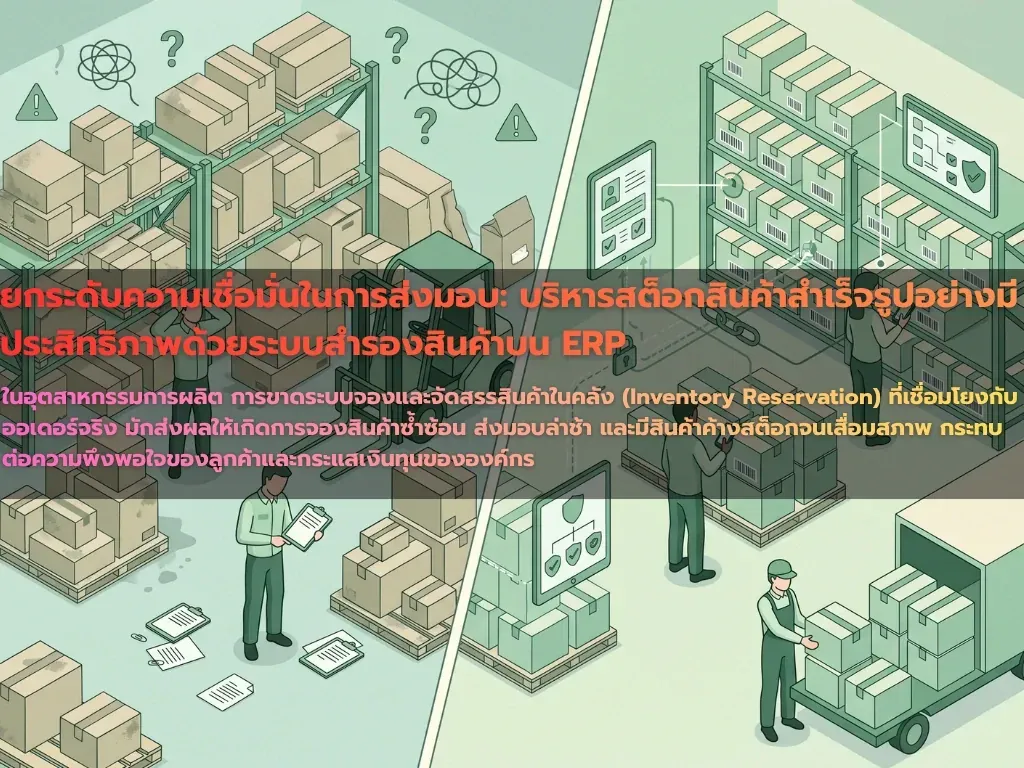
blog
In a manufacturing industry that demands agility, keeping the promise of a “delivery date” is a key competitive advantage. Yet a factory can find itself in a situation where goods are finished but cannot be delivered on time, because stock in the warehouse was not allocated fully or was reserved twice over.
When sales has no tool to check and reserve stock in real time, the warehouse tends to work on a “first come, first served” basis or keeps notes outside the system. This not only causes a scramble for stock to meet deliveries, it can also leave some lots held so long that they deteriorate, hurting cash flow and customer confidence.
The challenge of managing finished-goods stock without a connected reservation system
Without a reservation or allocation system that links sales, the warehouse and planning, three operating limitations usually follow:
- Double Booking: When the system shows only total On-Hand Inventory, without saying which customer a piece of stock is “locked” for, a salesperson may take a new order believing goods are still available to ship. The result is overlapping allocation and late delivery.
- Obsolete Inventory: If the system cannot clearly tie a reservation to a Sales Order and a delivery sequence, some lots may sit forgotten in a corner of the warehouse with no one issuing them, and end up as expired or outdated stock.
- Priority Management: When an urgent order arrives, changing issue entitlements is usually hard and confusing, because nothing shows clearly which stock can be reallocated and which is a Firm Commitment that must not be moved.
Building accuracy with finished-goods reservation and allocation in ERP
Organizations that want to be a trusted partner to their customers make ERP (Enterprise Resource Planning) software the core of warehouse management, so that reservation and distribution match real orders precisely:
1. Automatic Real-time Inventory Reservation
The ERP system turns finished-goods stock into live data. When sales opens a Sales Order, the system immediately reserves stock in the warehouse for that order, and clearly separates the stock status into On-Hand, Reserved and Available-to-Promise. This prevents double booking and lets every department see the same data.
2. Order-specific Allocation
The system can tie stock in the warehouse to a specific production lot or customer order code (Hard Allocation). The warehouse knows immediately which customer a lot was made for and which day it must be staged for the delivery truck, which reduces picking the wrong lot and makes the delivery history easy to trace back.
3. Strategic Re-allocation & FIFO Control
When market conditions or demand change, the ERP system lets the warehouse manager change reservation priorities transparently and in defined steps. At the same time, it controls the issue of finished goods by FIFO (First-In, First-Out), so goods produced first are always delivered first, reducing value lost to idle stock.
Conclusion: accurate reservation is the foundation of flawless delivery
“Producing quality goods is only half of success. The other half is getting those goods into the customer’s hands correctly and on time.”
Investing in ERP for warehouse management and reservation is not just about tidying the warehouse. It builds a delivery process that is smooth and predictable, protecting profit, reducing idle stock, and raising the confidence partners have in your organization on every order, for the long term.
Raise the accuracy of your reservations and deliveries. Consult an ERP implementation specialist for manufacturing and build a strong, agile back-office system today.
Theoretical references
- Chopra, S., & Meindl, P. (2016). Supply Chain Management: Strategy, Planning, and Operation (6th ed.). Pearson. (Cited for the principles of finished-goods inventory management, inventory allocation, and coordination between sales and distribution to improve accuracy in fulfilling orders.)
- Bardi, E. J., Coyle, J. J., & Gibson, B. (2016). Supply Chain Management: A Logistics Perspective (10th ed.). Cengage Learning. (Cited for the theory of warehouse control, inventory allocation systems, and managing delivery time to reduce the risk of lost sales opportunities and idle stock.)