Insights
Raising profit management: analyzing standard cost against actual production cost precisely with ERP
blog
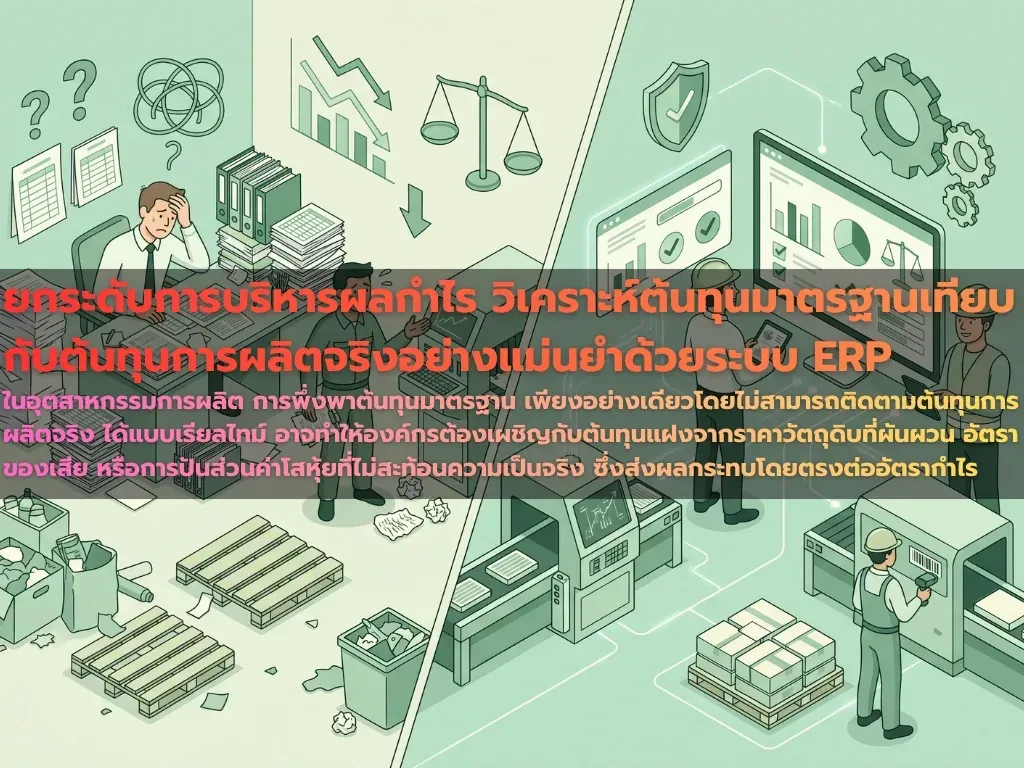
In manufacturing, steadily growing sales are a good sign for the business. But a key challenge many factory executives meet at financial close is that the true profit figure does not match what was estimated at the start. The main cause is often not just a mistake in setting the selling price, but the organization’s inability to see in time the gap between the planned “Standard Cost” and the “Actual Cost” incurred on the production line.
When raw material prices in the market fluctuate, scrap rates differ from one production run to the next, or overtime hours increase, relying on cost calculations kept in separate documents or spreadsheets can mean executives learn of cost variances too late to adjust the business plan.
The challenge of lacking real-time cost analysis
Managing production cost without a central data hub that links production, the warehouse and accounting usually leads to three operating limitations:
- Material Price & Usage Variance: Even with a clear Bill of Materials (BOM), in practice materials may be issued beyond the standard because of scrap, or because raw material prices have risen. If this cannot be detected immediately, these excess costs gradually erode the product’s margin.
- Labor & Overhead Allocation Gap: Hidden costs such as electricity, machine depreciation and direct labor are often allocated as a lump sum or from estimates, so the organization does not truly know which products earn the most profit and which carry more hidden cost than expected.
- Delayed Cost Visibility: Collecting material issue slips and timesheets from the shop floor and recalculating at every month-end takes a long time, leaving management without current data for deciding on price changes or controlling expenses in the next production cycle.
Raising the accuracy of production costing with ERP
Industrial organizations focused on sustainable growth make ERP (Enterprise Resource Planning) software the backbone that links production data to cost accounting, creating transparency down to every baht through three key mechanisms:
1. Linking the BOM to actual cost automatically
The ERP system uses the Bill of Materials as the basis for standard cost. When a Work Order is opened, the system pulls the cost of materials actually issued, at warehouse prices (for example FIFO or Moving Average), and records the comparison automatically. This makes the difference in material cost for each production lot clearly visible.
2. Systematic shop-floor cost recording (Work Center & Overhead Tracking)
The system can record the actual hours of workers and machines at each production step (Routing), and set the basis for allocating Manufacturing Overhead to each product precisely, so the unit cost reflects the reality of the factory floor as closely as possible.
3. Automated Cost Variance Analysis in real time
As soon as a Work Order is closed, the ERP system produces a Variance Report comparing standard cost with actual cost. It shows executives immediately what drove the variance, such as higher raw material prices, material use above standard, or lower machine efficiency, so production processes can be improved and pricing strategy planned accurately.
Conclusion: seeing the true cost is the key to protecting profit
“Effective cost control does not mean lowering product quality. It means seeing the true cost information at every step, in order to reduce waste and decide correctly.”
Investing in ERP that fully supports production costing and variance analysis turns shop-floor data into a strategic tool. It helps accounting close the books faster and helps executives protect the organization’s margin steadily over the long term.
Raise the accuracy of your costing and see the true profit of every production line. Consult an ERP implementation specialist for manufacturing and find the solution that fits your organization today.
Theoretical references
- Horngren, C. T., Datar, S. M., & Rajan, M. V. (2015). Cost Accounting: A Managerial Emphasis (15th ed.). Pearson. (Cited for the principles of Standard Costing and Variance Analysis of production cost, in both price and efficiency, for control and performance evaluation.)
- Drury, C. (2018). Management and Cost Accounting (10th ed.). Cengage Learning. (Cited for the theory of Overhead Allocation and the comparison of standard cost with actual cost, as information to support executives’ strategic decisions.)