Insights
Raising production-line continuity: managing and extending machine life with preventive maintenance in ERP
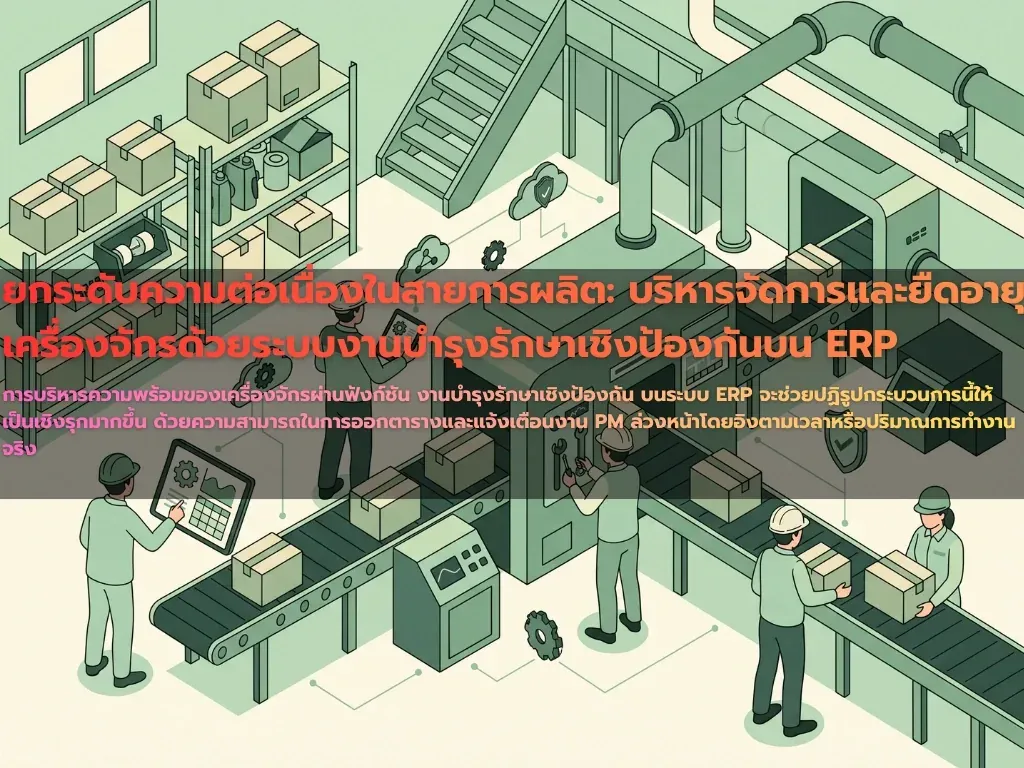
blog
In manufacturing, “machines” are the heart that keeps the business moving smoothly. But one of the challenges that most affects the continuity of production is machines breaking down without warning (Unplanned Downtime). It not only halts production suddenly, it also ripples through to the delivery plan, along with urgent repair costs that are hard to control.
Many organizations try to solve this with maintenance after the damage has occurred (Corrective Maintenance), which is often too late. Sustainable maintenance management has to shift to a proactive process, through effective “Preventive Maintenance”, to prevent problems before they actually happen.
The challenge of lacking a concrete maintenance management system
Managing machines without an information system that links the maintenance team, production and purchasing usually leads to three operating limitations:
- Inadequate Preventive Planning: Without advance alerts based on time cycles or usage hours (Usage-based), the maintenance team ends up firefighting whenever a machine stops. As a result, annual or monthly maintenance shutdowns cannot be planned properly.
- Spare Parts Inventory Imbalance: When maintenance work is not linked to warehouse data, an organization may run short of a critical spare part when it is needed urgently, or conversely order too much of some parts and tie up money in dead stock.
- Loss of Maintenance History: Recording repairs on paper or in separate programs makes breakdown history hard to search, and makes it impossible to assess a machine’s Overall Equipment Effectiveness (OEE) for long-term investment or improvement decisions.
Building steady continuity with preventive maintenance in ERP
Industrial organizations that care about operating efficiency make ERP (Enterprise Resource Planning) the center for planning and managing maintenance, so that every machine performs at full capacity, through three key functions:
1. Automated Preventive Maintenance Scheduling
The ERP system turns the preventive maintenance plan into an automated process. It calculates maintenance cycles from time (Time-based), such as every 30 days, or from working hours (Usage-based), then issues a Maintenance Order and alerts the maintenance team in advance. This lets planners choose the maintenance windows that disturb the production schedule the least.
2. Integrated Spare Parts Management
When the system issues a PM work order or a repair request, ERP checks the status of the needed spare parts in the warehouse and reserves them automatically. If the quantity is not enough, the system signals purchasing to order ahead. This reduces “machine waiting for parts” and keeps spare-parts stock at the most appropriate and cost-effective level.
3. Asset History & Performance Analytics
Every maintenance activity, the time it took and the cost incurred is stored as the history of each machine (Asset History) in ERP. Engineering and executives can use the data to find root causes, assess risk and calculate OEE, to plan a better maintenance strategy.
Conclusion: precise preventive maintenance is the heart of sustainable production
“Caring for and protecting machines before damage occurs not only preserves their working life, it also protects employees’ valuable time and the promises made to customers.”
Investing in ERP to manage preventive maintenance and repair work shifts operations from reacting to problems as they come to tight, proactive planning. It reduces losses from machine downtime and builds confidence in production standards that can serve customers every day.
Raise machine performance and reduce the risk of production-line interruptions. Consult an ERP implementation specialist for manufacturing and build the foundation of continuity for your factory today.
Theoretical references
- Vollmann, T. E., Berry, W. L., Whybark, D. C., & Jacobs, F. R. (2004). Manufacturing Planning and Control Systems for Supply Chain Management (5th ed.). McGraw-Hill. (Cited for the need to integrate production planning data with maintenance plans and capacity, to maintain availability and balance in operations.)
- Stevenson, W. J. (2020). Operations Management (14th ed.). McGraw-Hill Education. (Cited for the principles of Preventive Maintenance management and the analysis of the effect of machine Downtime on production performance and spare-parts inventory management.)